

Every district in Eldren leans toward the same place: the Dungeon Gate. The city's markets, forges, and healers all exist because adventurers keep going down and, sometimes, coming back up. This post gathers what I know so far about the dungeon at the heart of the setting, along with the questions I still need to answer before building it.
Design status: the dungeon described here is a concept. No floors, monsters, or loot tables exist in playable form yet.
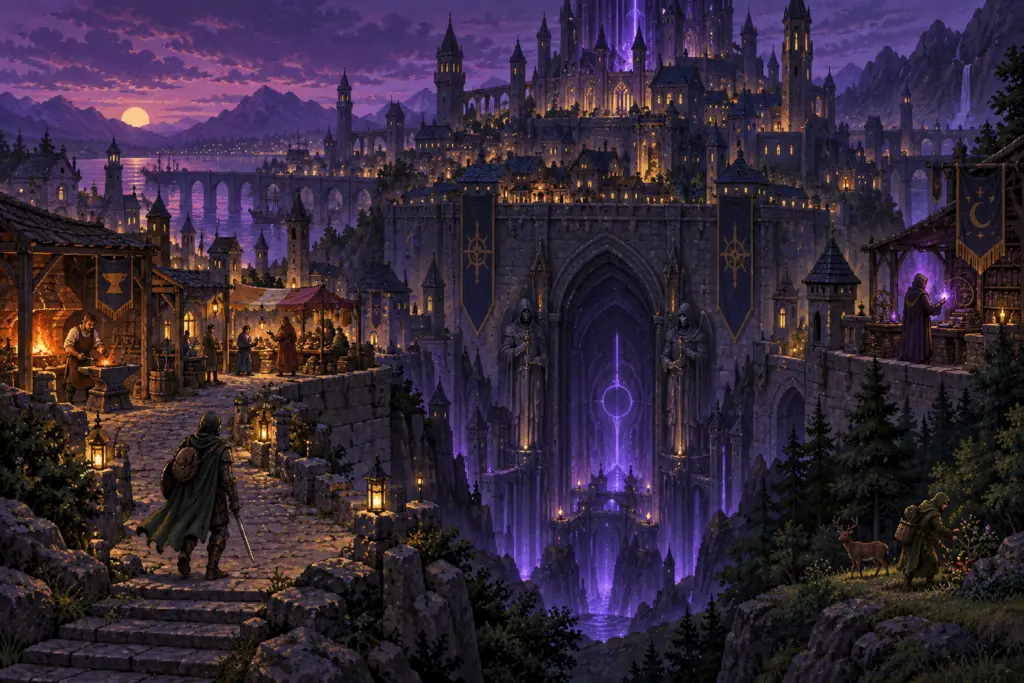
Concept art: an adventurer approaches the violet-lit dungeon beneath Eldren.
Listen: A Voice at the Dungeon Gate
To explore the mood of the setting, I made a short audio concept: an unnamed narrator who might one day greet new characters at the Dungeon Gate. It is a tone experiment, not final game audio.
Audio concept, 1 minute 1 second. A synthetic narrator voice speaks over quiet cave ambience, and the clip ends with a low creature growl. It plays only when you press play.
Transcript
[A low ambient drone. Water drips somewhere in the dark.]
Narrator: Beneath the city of Eldren, the stones remember every footstep. The city did not build the dungeon. The dungeon built the city. Its markets sell what adventurers carry back up. Its smiths forge what adventurers carry down. And its healers mend whoever returns. The deeper you descend, the richer the reward, and the fewer the footsteps that climb back out. So pack your bread. Mind your stamina. And choose your companions with care. The gate is open, traveler. It always is.
[A deep, rumbling growl rises from far below, then fades into the drone.]
How This Clip Was Made
I wrote the script for Eldren, then generated the voice with the speech synthesizer built into Windows. A short Python script lowered the voice, added a stone-hall echo, and mixed it with a cave ambience and a creature growl that were generated entirely in code, so no recorded or licensed audio was used. Following the W3C guidance on transcripts, the full text is provided above for anyone who cannot or prefers not to listen.
A City Built by Its Dungeon
The city of Eldren grew around the dungeon entrance, and each planned district has its own reason to care about what happens below:
- Market: where dungeon loot and gathered materials change hands.
- Adventurers' District: where expeditions form and gear is repaired.
- Crafting District: where smiths and alchemists turn raw materials into equipment.
- Slums: home to the desperate and the opportunistic.
- Noble District: wealth built on generations of dungeon trade.
- Dungeon Gate: the guarded threshold where every expedition begins.
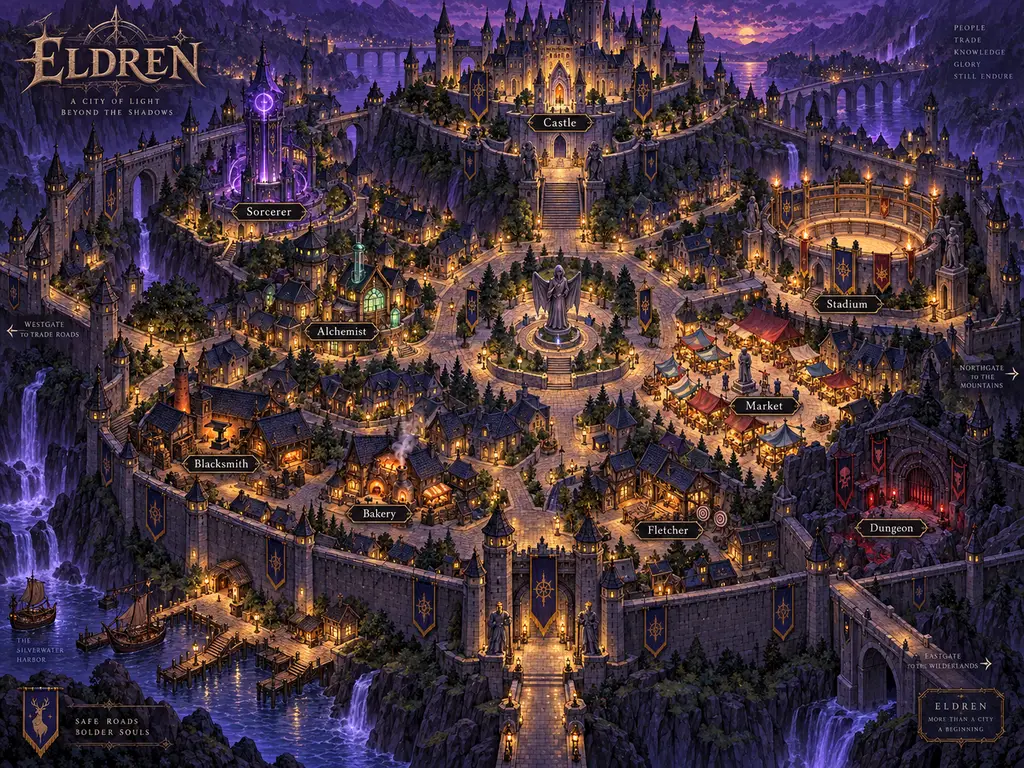
Concept map of Eldren. The district names are planning labels and may change.
Deeper Means More Dangerous
The Eldren Game Design page describes a dungeon with increasingly dangerous floors. In practice, I am working from five rules:
- Every floor should feel different, with its own enemies, resources, rules, and rewards.
- Risk and reward rise together, so the rarest materials and equipment come from the deepest floors.
- Threats come from monsters and players, which makes a deep expedition a social decision as well as a combat one.
- Retreat must be a real choice. Injuries, Hunger, and limited Stamina mean that knowing when to turn back is part of the skill.
- The dungeon is central but not mandatory. Crafters, merchants, and gatherers still need meaningful careers without fighting through it.
“The deeper you descend, the richer the reward, and the fewer the footsteps that climb back out.”
— The dungeon narrator, audio concept
Who Lives Below
All of the creature concepts are collected on the Eldren concept art page. These three are early candidates for the upper and middle floors:

Skeleton archer

Hellhound

Rock golem
Which creatures appear on which floors has not been decided. My current idea is that undead and goblin-kin fill the shallow floors, while elementals, golems, and the rare dragon belong much deeper.
Handcrafted or Procedural?
One of the biggest open questions is whether dungeon floors should be designed by hand or generated by code. A persistent online world needs floors that stay interesting after hundreds of visits, but players also need to learn the world and share what they know. Both approaches have trade-offs:
Handcrafted floors
- Pro: every room can be tuned and tested.
- Pro: players can share maps and routes.
- Con: a solo developer can only build so many floors.
- Con: repeated expeditions become predictable.
Procedural floors
- Pro: a fresh layout on every expedition.
- Pro: far more content from the same effort.
- Con: fair, readable layouts are harder to guarantee.
- Con: generated rooms can feel generic.
The option that interests me most is the hybrid approach used by Spelunky: hand-designed room templates assembled by an algorithm that guarantees a path from the entrance to the exit. Mark Brown of Game Maker's Toolkit explains how that system works in the video below.
Video: How (and Why) Spelunky Makes its Own Levels, by Game Maker's Toolkit on YouTube. The player does not autoplay, and captions are requested by default (they can be toggled with the CC button). Key points if you cannot watch: each Spelunky level is built on a four-by-four grid of rooms; the generator first lays out a guaranteed route from an entrance on the top row down to the exit; each room is then filled from hand-made templates with small random variations; the result is half designed and half generated, which keeps levels fresh while staying fair.
Next Steps
Early dungeon floors are planned for the Playable Core Systems phase of the Eldren development roadmap, with more floors and monsters coming in Content and Balance. Before then, I want to prototype a single floor both ways and compare them. For how combat on those floors might work, read Skills, Magic, and Combat in Eldren.